Your USDA zone, frost dates & safe-to-plant date — free.
The Garden Report gives you the four numbers every grower needs to start: your USDA hardiness zone, your average last and first frost dates, your growing-season length, and the date it's safe to plant. Calculated for your ZIP, emailed to keep.
We'll email your report and occasional seasonal planting tips. No spam — unsubscribe anytime.
The four numbers, in plain English
No jargon — just what each one means and why it decides what you can grow.
USDA hardiness zone
The USDA splits the country into zones by average coldest winter temperature, in 5°F bands like 6a, 6b, 7a. Your zone is the first thing to check before you buy a fruit tree or a native shrub — it tells you what can live through your winter, and what won't.
Last & first frost dates
Your average last spring frost is when it's usually safe for the season to begin; your first fall frost is when it usually ends. Almost everything you grow outdoors lives between those two dates — so they anchor your whole planting calendar.
Growing season
The stretch between your last spring frost and first fall frost — your frost-free days. It decides what will actually ripen in time where you live: a 70-day tomato is easy in a 184-day season, a long-season melon is a gamble in a short one.
Safe-to-plant date
Tomatoes, peppers, and basil die in a late frost. Your safe-to-plant date is when the risk has passed enough to move warm-season crops outside with confidence — usually a week or two after your average last frost.
Your Report in three steps
Enter your ZIP
No address, no account — just the five digits.
We pull your local climate data
Zone, frost dates, season length, and safe-to-plant date for your area.
It lands in your inbox
Yours to keep and check back on any time — free.
Know your calendar. Now map your light.
The Garden Report tells you when to plant. The free Sun Map shows you where the sun actually falls on your yard — a rainbow of real daylight hours over a satellite photo of your property. Use both, and you'll plant the right thing in the right spot at the right time.
Map my yard — free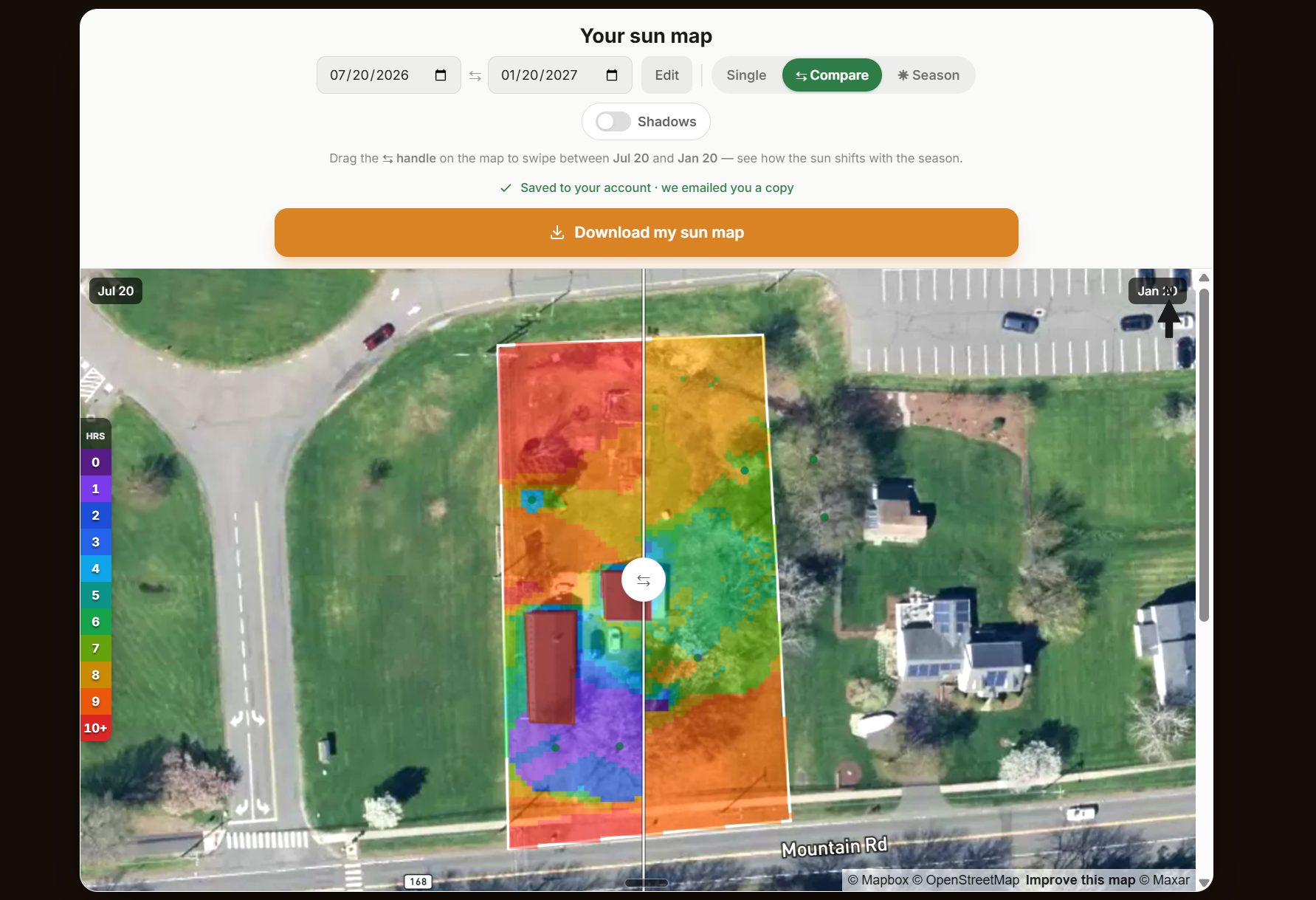
Garden Report FAQ
How do I find my USDA hardiness zone?
Enter your ZIP code in the Garden Report above and we'll return your exact zone (for example, 6b), free. Your zone is based on the average coldest winter temperature for your area.
What's the difference between my last frost date and my safe-to-plant date?
Your last frost date is the average date of your final spring freeze. Your safe-to-plant date adds a buffer after that for tender, warm-season crops like tomatoes and basil, which a surprise late frost would kill.
Are the frost dates guaranteed?
No — they're averages drawn from decades of local climate data. Weather varies year to year, so treat them as a reliable guide rather than a promise, and keep an eye on your local forecast near the edges of the season.
Is the Garden Report really free?
Yes. There's no account and no credit card. Enter your ZIP and email and the Report is yours to keep.
Do I need to map my yard to get it?
No. The Garden Report needs only your ZIP. And if you do map your yard with our free sun map, the Report comes with it automatically — we won't ask twice.
What can I plant during my growing season?
Your frost-free days tell you what will ripen in time — match a crop's “days to maturity” to your season length. The Planner (coming soon) does this matching for you and places each plant by your yard's real sunlight.
Get your Garden Report.
The four numbers every grower needs to start — calculated for your ZIP and emailed to keep.
We'll email your report and occasional seasonal planting tips. No spam — unsubscribe anytime.